
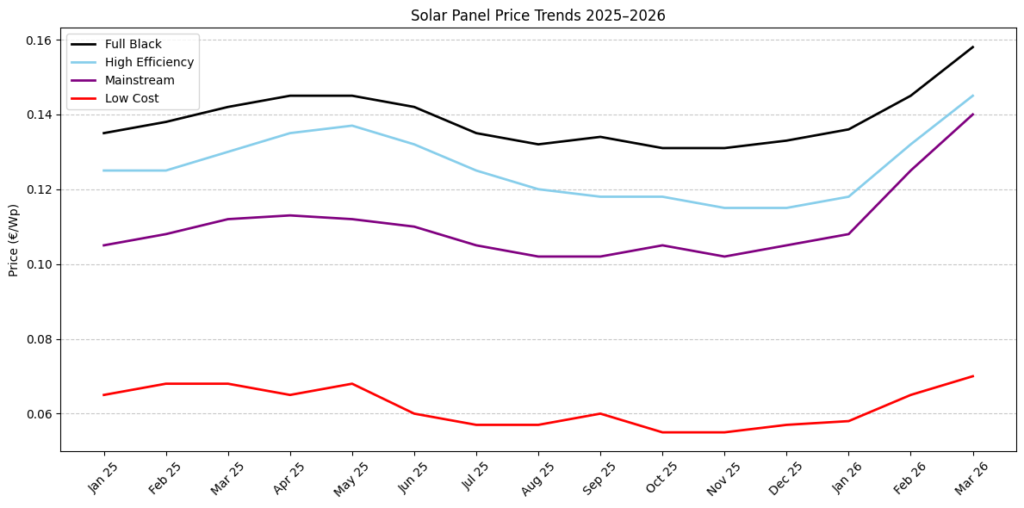
For more than a decade, solar panel costs have trended downwards. Year after year, falling module prices made solar more affordable and easier to justify financially. That era is ending.
A structural shift in global solar supply chains, driven by policy changes, market economics, and raw material trends, is set to push up the cost of solar panels and other key components in 2026. The clearest trigger point is 1 April 2026, when China, the dominant supplier of photovoltaic (PV) modules worldwide, removes export tax rebates that have underpinned a decade of ultra‑low panel prices.
Understanding this price pivot is critical if you’re thinking about solar on your home or rental property.
Why Solar Panel Prices Are About to Rise
1. China Will Remove Export Tax Rebates on Solar Panels
China supplies the vast majority of solar PV modules used in the UK and Europe. To support exports, Chinese manufacturers have benefited from value‑added tax (VAT) rebates on solar panels and related components for years. From 1 April 2026, these rebates will be completely eliminated.
This change directly affects the cost base of Chinese exporters. Without rebates, manufacturers face higher effective export taxes and are likely to pass significant portions of that cost on to international buyers.
Several independent market forecasters and industry analysts now project that panel prices could increase by around 10–15 per cent or more once these rebates disappear.
2. Supply Chain Pressures Are Already Building
Panel pricing isn’t driven by export policy alone. Costs are being pushed up by:
- Rising raw material prices, especially silver, which is used in cell interconnections and has seen recent price surges.
- Polysilicon and wafer supply adjustments, as manufacturers consolidate capacity and stricter production policies take hold.
- Reduced pricing flexibility in the PV industry as export incentives disappear and manufacturers have less room to absorb cost inflation.
The combined effect is market tightness. Distributors and installers are already reporting rising procurement costs for modules and components in early 2026, even ahead of the official rebate changes.
3. Global Market Shock Dynamics
Industry commentary suggests that the withdrawal of rebates doesn’t just remove a price support; it also accelerates pre‑buying and forward contracting in the first quarter of 2026. Manufacturers are filling order books ahead of April to avoid the higher cost base. This surge in demand can itself push prices up before the policy change lands.
When Prices Are Likely to Rise
The timeline now looks like this:
- Late 2025 – Early 2026: Panel manufacturers and global buyers begun to anticipate the tax rebate cut. Some price pressure emerges as suppliers push shipments and buyers lock in orders.
- January–March 2026: Pre‑April procurement activity intensifies. Module, cell, and raw material prices begin a general upward drift.
- 1 April 2026: Export tax rebates on Chinese PV products are removed entirely. Prices are expected to step noticeably higher around this point, potentially 10–15 per cent higher than early 2026 levels, with some reports suggesting even steeper cost adjustments in parts of the supply chain.
- Q2 2026 onward: Adjustments ripple through wholesale and installer pricing. UK project costs will reflect these global trends as imported modules form the bulk of supply.
This isn’t speculation; major industry data providers and solar trade publications are already signalling that module pricing volatility and upward pressure are shaping up now, not late in 2026.
What This Means for Domestic Solar Buyers
If you’re weighing up solar for your home or rental property, the takeaway is stark:
Every quarter you wait risks paying more for equipment that could already be rising in price.
Here’s the simple reality:
- You lock in current pricing and supplier availability now.
- Installations completed before the April policy change effectively avoid the bulk of the expected cost inflation.
- You start benefiting from lower energy bills and greater energy independence sooner, at a known cost.
Importantly, solar still delivers excellent long‑term value; the fundamentals of self‑consumption economics haven’t deteriorated. It’s just that the upfront hardware cost, historically the largest single component of a solar installation, is set to increase. That makes acting now materially more cost‑effective than delaying into the second half of 2026.
Don’t Just Take Our Word for It
Industry reporting has consistently pointed to rising panel prices and supply chain tightness as a result of China’s policy shift and broader market dynamics. Recent analyses highlight both pre‑buying trends and forecasts of meaningful price correction in modules once export incentives vanish.
Bottom Line
Solar panel prices are at a rare inflection point. After years of falling costs, global factors, especially China’s removal of export tax rebates from April 2026, mean prices are likely to rise.
If you’re considering solar for your home or rental property, now is the best time to act. Locking in an installation before April 2026 reduces the risk of higher hardware costs and helps you capture energy independence and financial returns before market pricing normalises at a higher base.
Speak to our team today to receive your FREE solar proposal.
Contact Us Form
"*" indicates required fields